# Formulate a Cloud Storage destination path for the data exported from BigQuery.
# NOTE: By default data exported multiple times on the same day will overwrite older copies.
#       But data exported on a different days will write to a new location so that historical
#       copies can be kept as the dataset definition is changed.
survey_61548618_path <- file.path(
  Sys.getenv("WORKSPACE_BUCKET"),
  "bq_exports",
  Sys.getenv("OWNER_EMAIL"),
  strftime(lubridate::now(), "%Y%m%d"),  # Comment out this line if you want the export to always overwrite.
  "survey_61548618",
  "survey_61548618_*.csv")
message(str_glue('The data will be written to {survey_61548618_path}. Use this path when reading ',
                 'the data into your notebooks in the future.'))

# Perform the query and export the dataset to Cloud Storage as CSV files.
# NOTE: You only need to run `bq_table_save` once. After that, you can
#       just read data from the CSVs in Cloud Storage.
bq_table_save(
  bq_dataset_query(Sys.getenv("WORKSPACE_CDR"), dataset_61548618_survey_sql, billing = Sys.getenv("GOOGLE_PROJECT")),
  survey_61548618_path,
  destination_format = "CSV")


# Read the data directly from Cloud Storage into memory.
# NOTE: Alternatively you can `gsutil -m cp {survey_61548618_path}` to copy these files
#       to the Jupyter disk.
read_bq_export_from_workspace_bucket <- function(export_path) {
  col_types <- cols(survey = col_character(), question = col_character(), answer = col_character(), survey_version_name = col_character())
  bind_rows(
    map(system2('gsutil', args = c('ls', export_path), stdout = TRUE, stderr = TRUE),
        function(csv) {
          message(str_glue('Loading {csv}.'))
          chunk <- read_csv(pipe(str_glue('gsutil cat {csv}')), col_types = col_types, show_col_types = FALSE)
          if (is.null(col_types)) {
            col_types <- spec(chunk)
          }
          chunk
        }))
}
dataset_61548618_survey_df <- read_bq_export_from_workspace_bucket(survey_61548618_path)allofus: an R package to facilitate use of the All of Us Researcher Workbench
Louisa Smith, PhD
The Roux Institute at Northeastern University
Bouve College of Health Sciences, Northeastern University
allofus R package authors

Louisa Smith
- Assistant Professor at Northeastern University in the department of Public Health and Health Sciences and at the Roux Institute

Rob Cavanaugh
- Assistant Professor at the Massachusetts General Hospital Institute for Health Professions with appointments in Communication Science and Disorders and Genetic Counseling
All of Us Research Program
- Launched in 2018 by the National Institutes of Health (NIH)
- Goal: gather data from 1 million or more people living in the United States to accelerate research and improve health
- Data types: EHR, surveys, physical measurements, genomics, wearables
- Right now about 600,000 have EHR, initial surveys, physical measurements, biospecimens
All of Us Researcher Workbench
- Cloud-based platform to access All of Us data for analysis
- Data stored in Google BigQuery in the OMOP Common Data Model
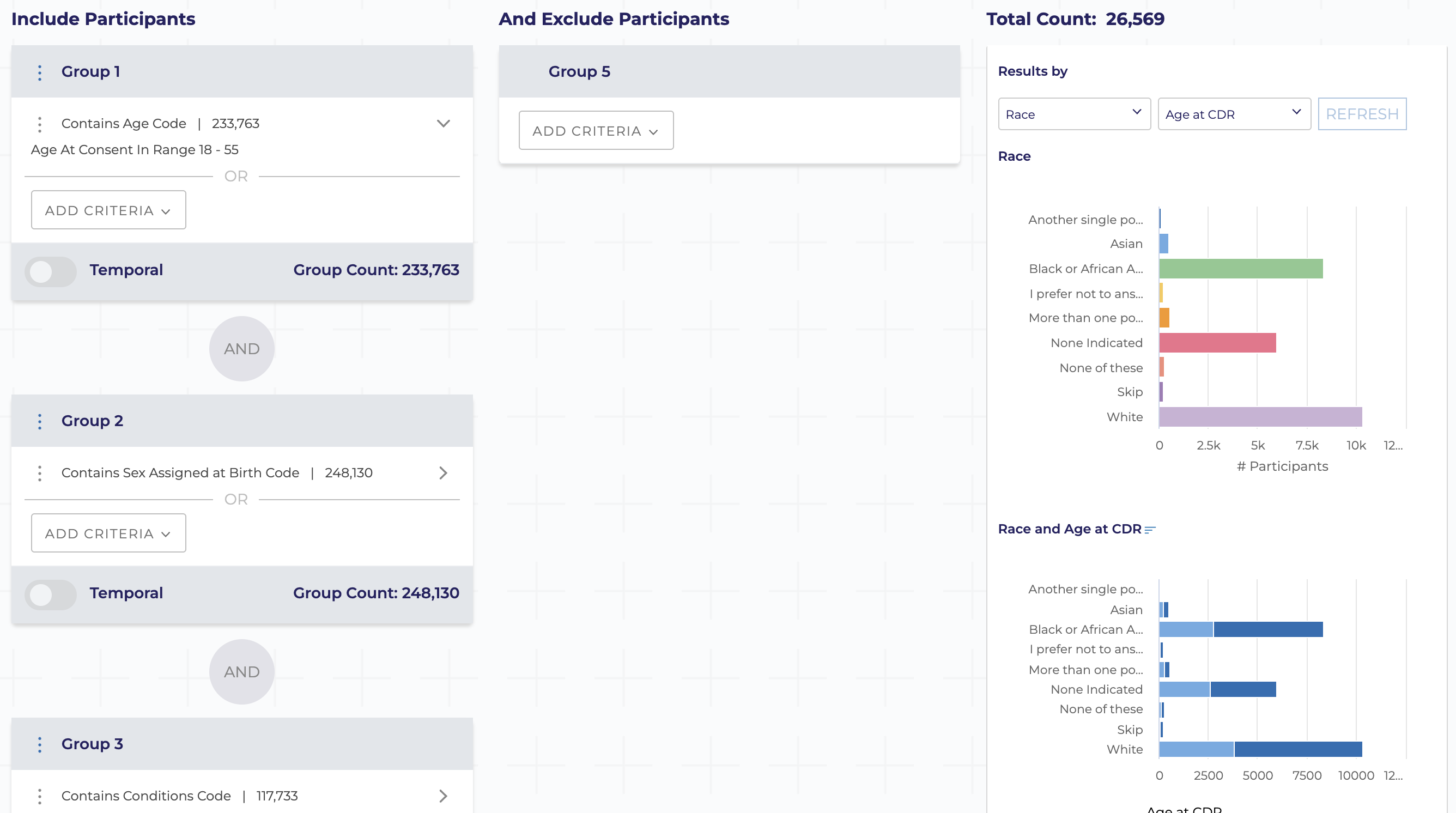
- Access directly via SQL queries or using Cohort Builder tool
- Analysis in R, Python, or SAS
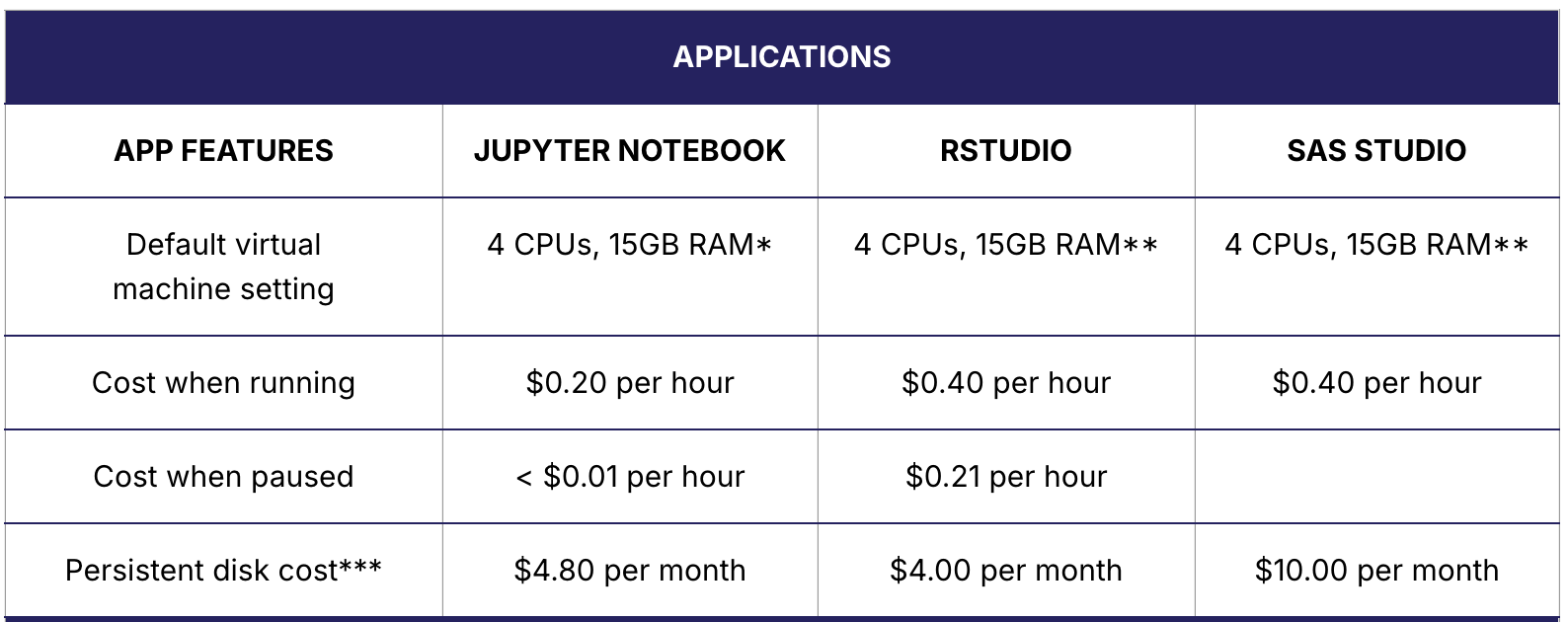
Costs
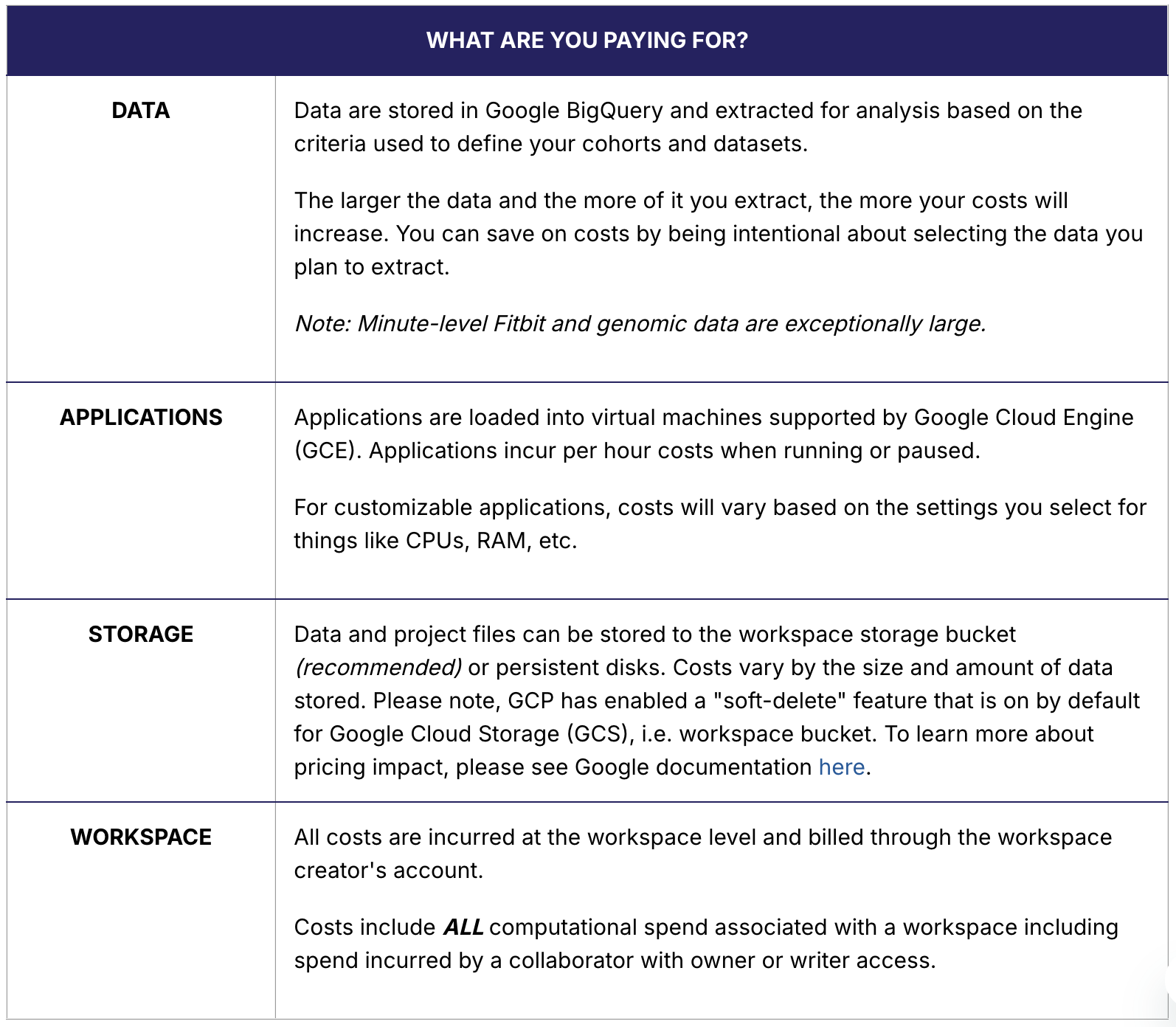
Costs
Cohort Builder
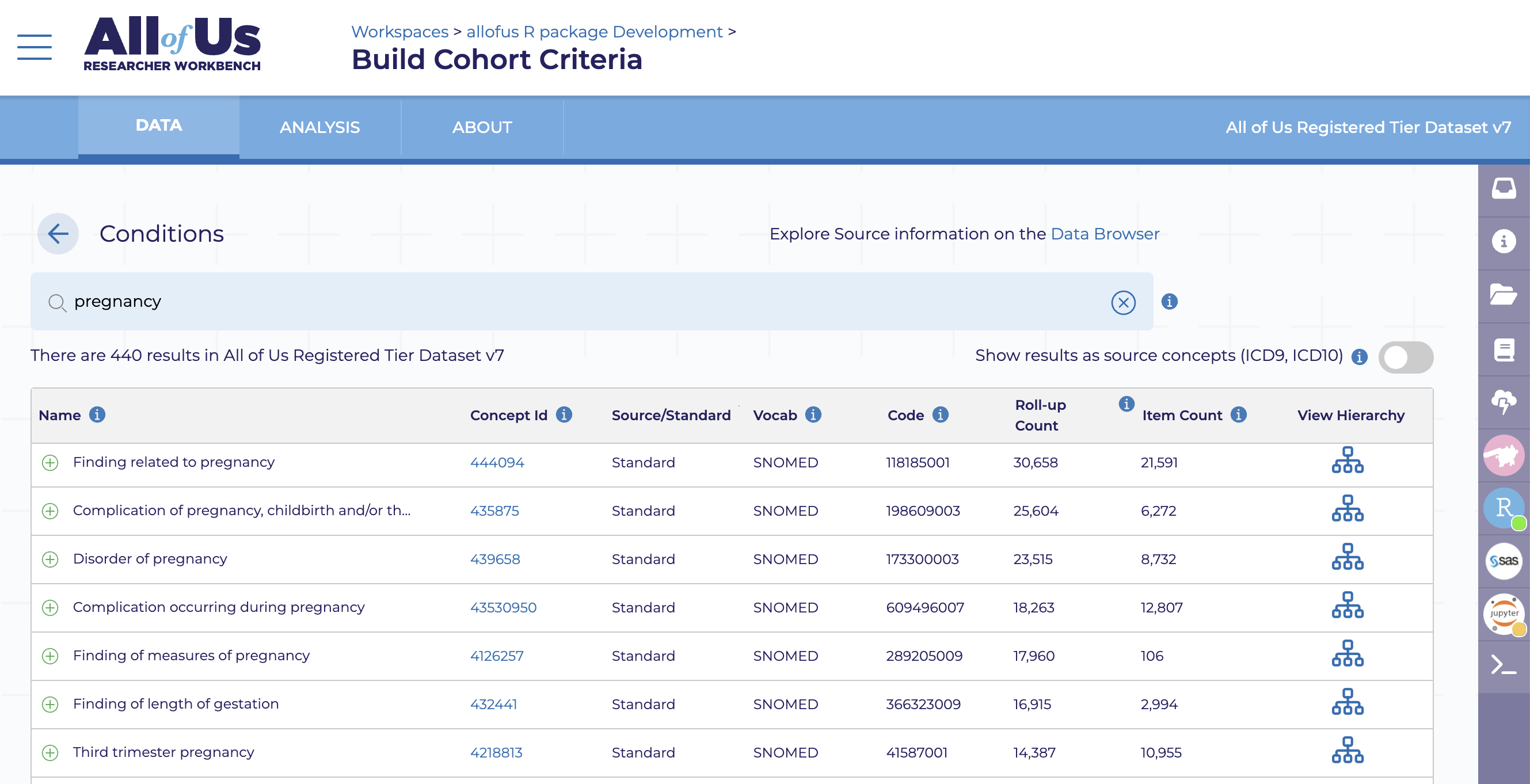
Concept Set Builder
Dataset Builder
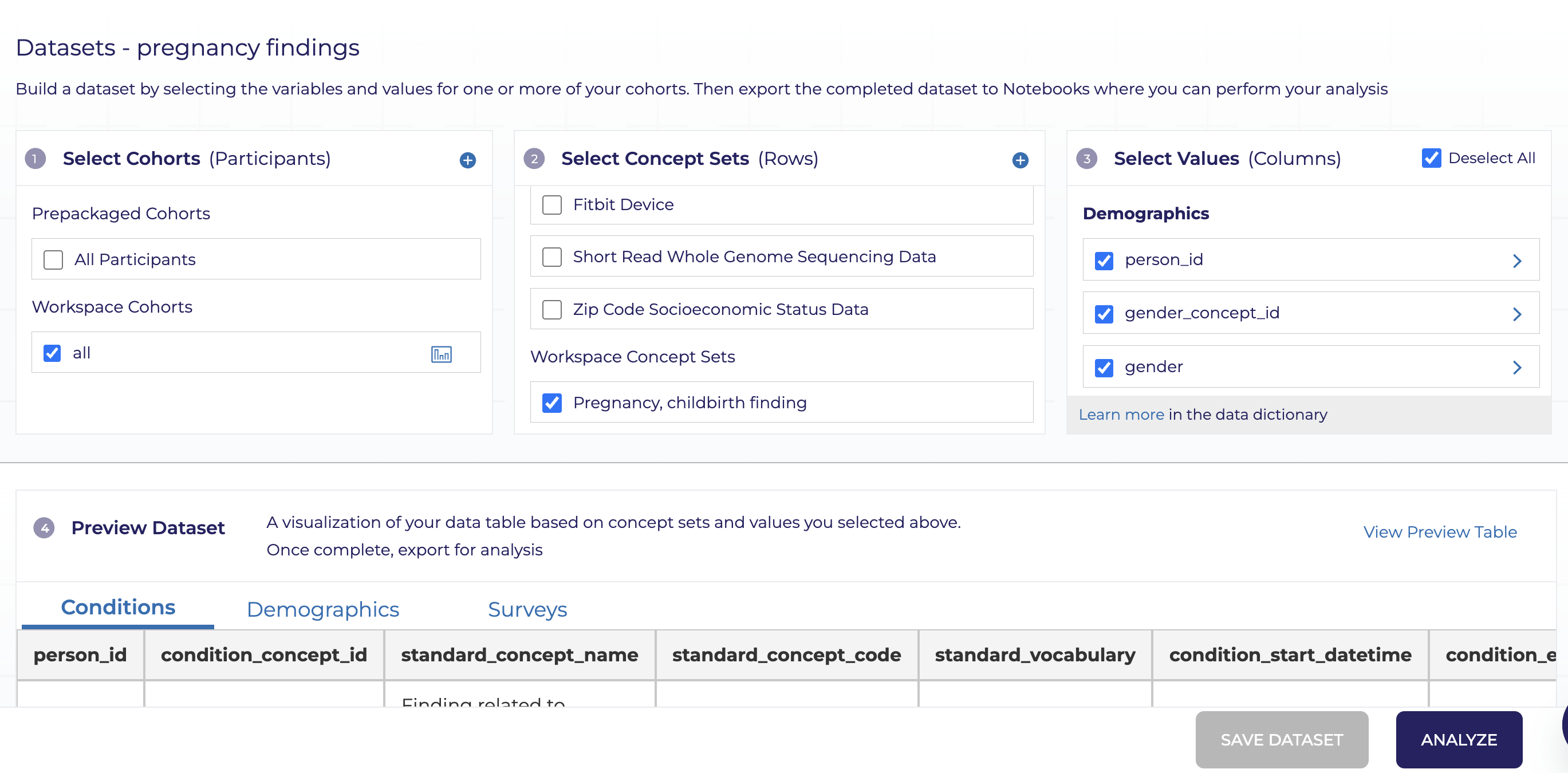
Creates code
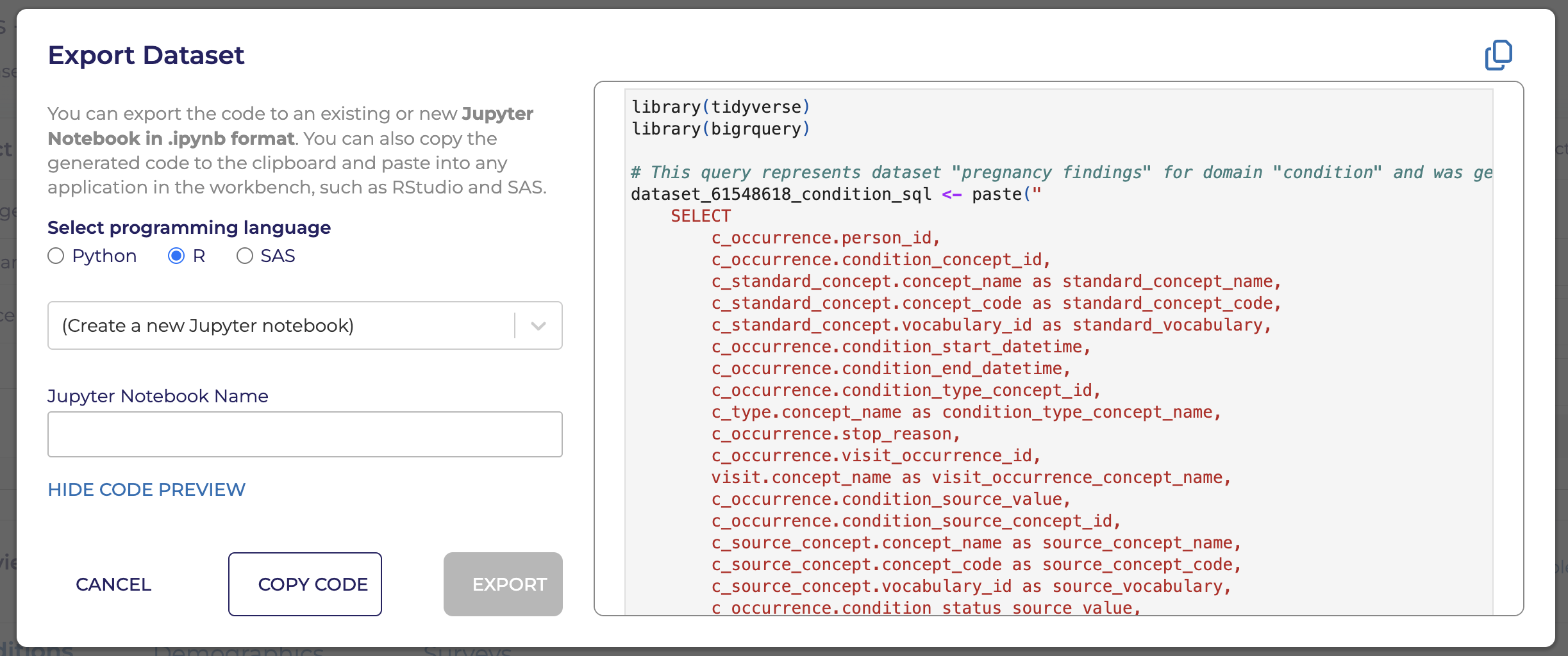
Code writes csv files
Challenges
- Point-and-click tools very limited, results in huge csv files
- But lack of programming skills…
- Health researchers often use R or SAS, some use python, few use SQL
tidyverseis (the most?) popular framework for R
- All of Us data is complex
- the OMOP CDM has a steep learning curve, plus the complexity of the other data (e.g., surveys)
- many researchers are trained on cleaner, more straightforward data
- Large scale observational health research is hard
- defining cohorts with appropriate inclusion/exclusion criteria, exposure/outcome phenotypes, time under observation, etc.
- reproducibility is critical
allofus R package
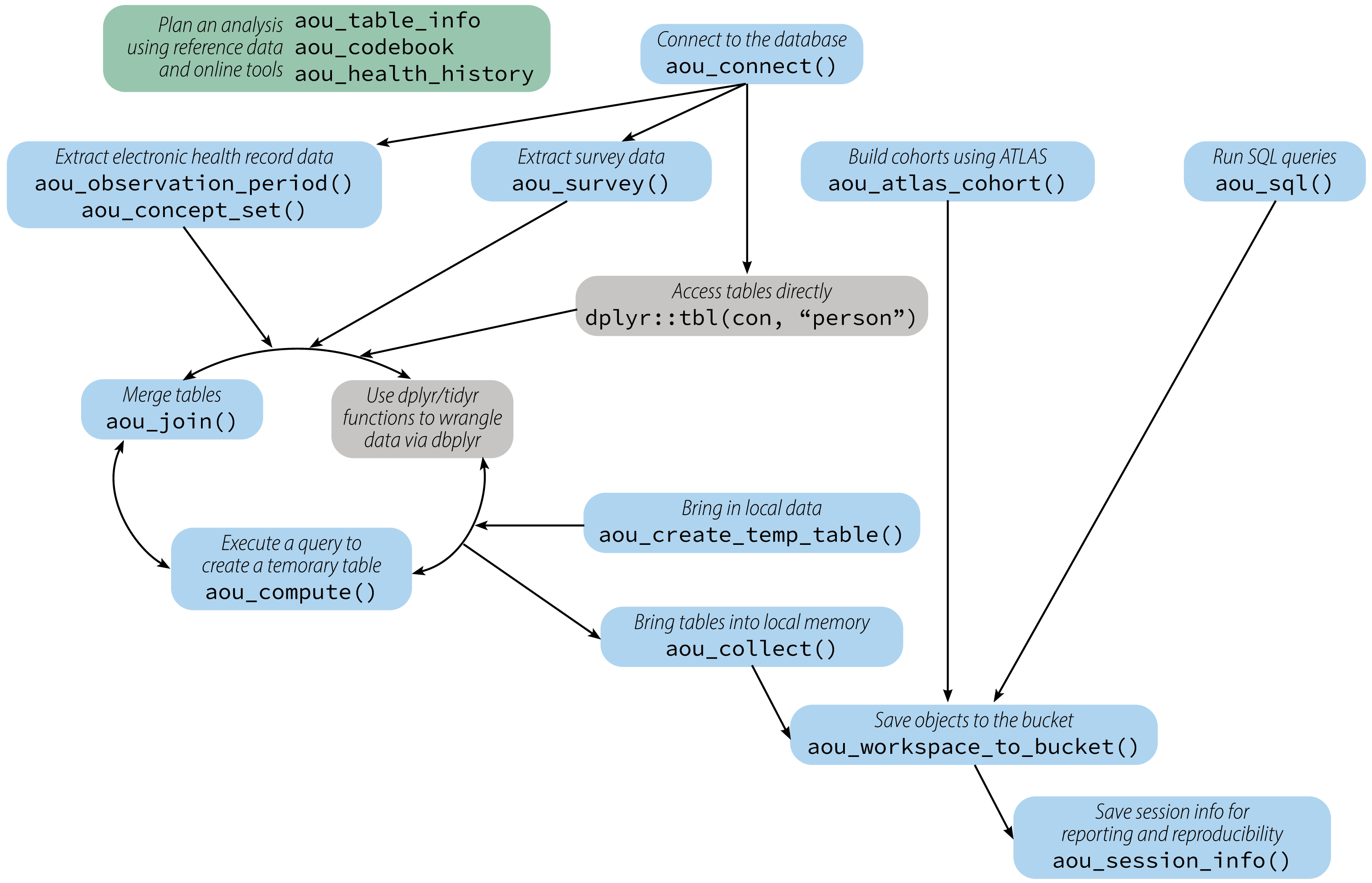
- Build on existing tools/skills
- Enable complex research
- Efficient (compared to built-in tools)
- Readable and reproducible
Begin in R, not Cohort Builder
Access tables
Under the hood, dbplyr (part of the tidyverse) allows researchers to use many of the same functions on a remote table that they would use on a dataframe
Quick data manipulations and computations
Users are running SQL queries without realizing they’re running SQL queries
Creating cohorts with allofus
Error:
! object 'con' not foundError:
! object 'con' not foundError:
! object 'reproductive_age_female' not foundError:
! object 'cohort' not foundCreating datasets with Cohort Builder
library(tidyverse)
library(bigrquery)
# This query represents dataset "hypertension in pregnancy" for domain "person" and was generated for All of Us Registered Tier Dataset v7
dataset_71250616_person_sql <- paste("
SELECT
person.person_id,
person.gender_concept_id,
p_gender_concept.concept_name as gender,
person.birth_datetime as date_of_birth,
person.race_concept_id,
p_race_concept.concept_name as race,
person.ethnicity_concept_id,
p_ethnicity_concept.concept_name as ethnicity,
person.sex_at_birth_concept_id,
p_sex_at_birth_concept.concept_name as sex_at_birth
FROM
`person` person
LEFT JOIN
`concept` p_gender_concept
ON person.gender_concept_id = p_gender_concept.concept_id
LEFT JOIN
`concept` p_race_concept
ON person.race_concept_id = p_race_concept.concept_id
LEFT JOIN
`concept` p_ethnicity_concept
ON person.ethnicity_concept_id = p_ethnicity_concept.concept_id
LEFT JOIN
`concept` p_sex_at_birth_concept
ON person.sex_at_birth_concept_id = p_sex_at_birth_concept.concept_id
WHERE
person.PERSON_ID IN (SELECT
distinct person_id
FROM
`cb_search_person` cb_search_person
WHERE
cb_search_person.person_id IN (SELECT
person_id
FROM
`cb_search_person` p
WHERE
age_at_consent BETWEEN 18 AND 50
AND cb_search_person.person_id IN (SELECT
person_id
FROM
`person` p
WHERE
sex_at_birth_concept_id IN (45878463) )
AND cb_search_person.person_id IN (SELECT
criteria.person_id
FROM
(SELECT
DISTINCT person_id, entry_date, concept_id
FROM
`cb_search_all_events`
WHERE
(concept_id IN(SELECT
DISTINCT c.concept_id
FROM
`cb_criteria` c
JOIN
(SELECT
CAST(cr.id as string) AS id
FROM
`cb_criteria` cr
WHERE
concept_id IN (316866)
AND full_text LIKE '%_rank1]%' ) a
ON (c.path LIKE CONCAT('%.', a.id, '.%')
OR c.path LIKE CONCAT('%.', a.id)
OR c.path LIKE CONCAT(a.id, '.%')
OR c.path = a.id)
WHERE
is_standard = 1
AND is_selectable = 1)
AND is_standard = 1 )) criteria ) )", sep="")
# Formulate a Cloud Storage destination path for the data exported from BigQuery.
# NOTE: By default data exported multiple times on the same day will overwrite older copies.
# But data exported on a different days will write to a new location so that historical
# copies can be kept as the dataset definition is changed.
person_71250616_path <- file.path(
Sys.getenv("WORKSPACE_BUCKET"),
"bq_exports",
Sys.getenv("OWNER_EMAIL"),
strftime(lubridate::now(), "%Y%m%d"), # Comment out this line if you want the export to always overwrite.
"person_71250616",
"person_71250616_*.csv")
message(str_glue('The data will be written to {person_71250616_path}. Use this path when reading ',
'the data into your notebooks in the future.'))
# Perform the query and export the dataset to Cloud Storage as CSV files.
# NOTE: You only need to run `bq_table_save` once. After that, you can
# just read data from the CSVs in Cloud Storage.
bq_table_save(
bq_dataset_query(Sys.getenv("WORKSPACE_CDR"), dataset_71250616_person_sql, billing = Sys.getenv("GOOGLE_PROJECT")),
person_71250616_path,
destination_format = "CSV")
# Read the data directly from Cloud Storage into memory.
# NOTE: Alternatively you can `gsutil -m cp {person_71250616_path}` to copy these files
# to the Jupyter disk.
read_bq_export_from_workspace_bucket <- function(export_path) {
col_types <- cols(gender = col_character(), race = col_character(), ethnicity = col_character(), sex_at_birth = col_character())
bind_rows(
map(system2('gsutil', args = c('ls', export_path), stdout = TRUE, stderr = TRUE),
function(csv) {
message(str_glue('Loading {csv}.'))
chunk <- read_csv(pipe(str_glue('gsutil cat {csv}')), col_types = col_types, show_col_types = FALSE)
if (is.null(col_types)) {
col_types <- spec(chunk)
}
chunk
}))
}
dataset_71250616_person_df <- read_bq_export_from_workspace_bucket(person_71250616_path)
dim(dataset_71250616_person_df)
head(dataset_71250616_person_df, 5)
library(tidyverse)
library(bigrquery)
# This query represents dataset "hypertension in pregnancy" for domain "condition" and was generated for All of Us Registered Tier Dataset v7
dataset_71250616_condition_sql <- paste("
SELECT
c_occurrence.person_id,
c_occurrence.condition_concept_id,
c_standard_concept.concept_name as standard_concept_name,
c_standard_concept.concept_code as standard_concept_code,
c_standard_concept.vocabulary_id as standard_vocabulary,
c_occurrence.condition_start_datetime,
c_occurrence.condition_end_datetime,
c_occurrence.condition_type_concept_id,
c_type.concept_name as condition_type_concept_name,
c_occurrence.stop_reason,
c_occurrence.visit_occurrence_id,
visit.concept_name as visit_occurrence_concept_name,
c_occurrence.condition_source_value,
c_occurrence.condition_source_concept_id,
c_source_concept.concept_name as source_concept_name,
c_source_concept.concept_code as source_concept_code,
c_source_concept.vocabulary_id as source_vocabulary,
c_occurrence.condition_status_source_value,
c_occurrence.condition_status_concept_id,
c_status.concept_name as condition_status_concept_name
FROM
( SELECT
*
FROM
`condition_occurrence` c_occurrence
WHERE
(
condition_concept_id IN (SELECT
DISTINCT c.concept_id
FROM
`cb_criteria` c
JOIN
(SELECT
CAST(cr.id as string) AS id
FROM
`cb_criteria` cr
WHERE
concept_id IN (132685, 133816, 134414, 135601, 136743, 137613, 138811, 141084, 314090, 35622939, 4034096, 4057976, 4116344, 4283352, 433536, 438490, 439077, 439393, 443700)
AND full_text LIKE '%_rank1]%' ) a
ON (c.path LIKE CONCAT('%.', a.id, '.%')
OR c.path LIKE CONCAT('%.', a.id)
OR c.path LIKE CONCAT(a.id, '.%')
OR c.path = a.id)
WHERE
is_standard = 1
AND is_selectable = 1)
)
AND (
c_occurrence.PERSON_ID IN (SELECT
distinct person_id
FROM
`cb_search_person` cb_search_person
WHERE
cb_search_person.person_id IN (SELECT
person_id
FROM
`cb_search_person` p
WHERE
age_at_consent BETWEEN 18 AND 50
AND cb_search_person.person_id IN (SELECT
person_id
FROM
`person` p
WHERE
sex_at_birth_concept_id IN (45878463) )
AND cb_search_person.person_id IN (SELECT
criteria.person_id
FROM
(SELECT
DISTINCT person_id, entry_date, concept_id
FROM
`cb_search_all_events`
WHERE
(concept_id IN(SELECT
DISTINCT c.concept_id
FROM
`cb_criteria` c
JOIN
(SELECT
CAST(cr.id as string) AS id
FROM
`cb_criteria` cr
WHERE
concept_id IN (316866)
AND full_text LIKE '%_rank1]%' ) a
ON (c.path LIKE CONCAT('%.', a.id, '.%')
OR c.path LIKE CONCAT('%.', a.id)
OR c.path LIKE CONCAT(a.id, '.%')
OR c.path = a.id)
WHERE
is_standard = 1
AND is_selectable = 1)
AND is_standard = 1 )) criteria ) )
)) c_occurrence
LEFT JOIN
`concept` c_standard_concept
ON c_occurrence.condition_concept_id = c_standard_concept.concept_id
LEFT JOIN
`concept` c_type
ON c_occurrence.condition_type_concept_id = c_type.concept_id
LEFT JOIN
`visit_occurrence` v
ON c_occurrence.visit_occurrence_id = v.visit_occurrence_id
LEFT JOIN
`concept` visit
ON v.visit_concept_id = visit.concept_id
LEFT JOIN
`concept` c_source_concept
ON c_occurrence.condition_source_concept_id = c_source_concept.concept_id
LEFT JOIN
`concept` c_status
ON c_occurrence.condition_status_concept_id = c_status.concept_id", sep="")
# Formulate a Cloud Storage destination path for the data exported from BigQuery.
# NOTE: By default data exported multiple times on the same day will overwrite older copies.
# But data exported on a different days will write to a new location so that historical
# copies can be kept as the dataset definition is changed.
condition_71250616_path <- file.path(
Sys.getenv("WORKSPACE_BUCKET"),
"bq_exports",
Sys.getenv("OWNER_EMAIL"),
strftime(lubridate::now(), "%Y%m%d"), # Comment out this line if you want the export to always overwrite.
"condition_71250616",
"condition_71250616_*.csv")
message(str_glue('The data will be written to {condition_71250616_path}. Use this path when reading ',
'the data into your notebooks in the future.'))
# Perform the query and export the dataset to Cloud Storage as CSV files.
# NOTE: You only need to run `bq_table_save` once. After that, you can
# just read data from the CSVs in Cloud Storage.
bq_table_save(
bq_dataset_query(Sys.getenv("WORKSPACE_CDR"), dataset_71250616_condition_sql, billing = Sys.getenv("GOOGLE_PROJECT")),
condition_71250616_path,
destination_format = "CSV")
# Read the data directly from Cloud Storage into memory.
# NOTE: Alternatively you can `gsutil -m cp {condition_71250616_path}` to copy these files
# to the Jupyter disk.
read_bq_export_from_workspace_bucket <- function(export_path) {
col_types <- cols(standard_concept_name = col_character(), standard_concept_code = col_character(), standard_vocabulary = col_character(), condition_type_concept_name = col_character(), stop_reason = col_character(), visit_occurrence_concept_name = col_character(), condition_source_value = col_character(), source_concept_name = col_character(), source_concept_code = col_character(), source_vocabulary = col_character(), condition_status_source_value = col_character(), condition_status_concept_name = col_character())
bind_rows(
map(system2('gsutil', args = c('ls', export_path), stdout = TRUE, stderr = TRUE),
function(csv) {
message(str_glue('Loading {csv}.'))
chunk <- read_csv(pipe(str_glue('gsutil cat {csv}')), col_types = col_types, show_col_types = FALSE)
if (is.null(col_types)) {
col_types <- spec(chunk)
}
chunk
}))
}
dataset_71250616_condition_df <- read_bq_export_from_workspace_bucket(condition_71250616_path)
dim(dataset_71250616_condition_df)
head(dataset_71250616_condition_df, 5)
library(tidyverse)
library(bigrquery)
# This query represents dataset "hypertension in pregnancy" for domain "measurement" and was generated for All of Us Registered Tier Dataset v7
dataset_71250616_measurement_sql <- paste("
SELECT
measurement.person_id,
measurement.measurement_concept_id,
m_standard_concept.concept_name as standard_concept_name,
m_standard_concept.concept_code as standard_concept_code,
m_standard_concept.vocabulary_id as standard_vocabulary,
measurement.measurement_datetime,
measurement.measurement_type_concept_id,
m_type.concept_name as measurement_type_concept_name,
measurement.operator_concept_id,
m_operator.concept_name as operator_concept_name,
measurement.value_as_number,
measurement.value_as_concept_id,
m_value.concept_name as value_as_concept_name,
measurement.unit_concept_id,
m_unit.concept_name as unit_concept_name,
measurement.range_low,
measurement.range_high,
measurement.visit_occurrence_id,
m_visit.concept_name as visit_occurrence_concept_name,
measurement.measurement_source_value,
measurement.measurement_source_concept_id,
m_source_concept.concept_name as source_concept_name,
m_source_concept.concept_code as source_concept_code,
m_source_concept.vocabulary_id as source_vocabulary,
measurement.unit_source_value,
measurement.value_source_value
FROM
( SELECT
*
FROM
`measurement` measurement
WHERE
(
measurement_concept_id IN (SELECT
DISTINCT c.concept_id
FROM
`cb_criteria` c
JOIN
(SELECT
CAST(cr.id as string) AS id
FROM
`cb_criteria` cr
WHERE
concept_id IN (21490851, 21490853, 3004249, 3005606, 3009395, 3012526, 3012888, 3013940, 3017490, 3018586, 3018592, 3018822, 3019962, 3027598, 3028737, 3031203, 3034703, 3035856, 36716965, 4060834, 40758413, 4152194, 4154790, 4232915, 4239021, 4248524, 4298393, 4302410, 44789315, 44789316)
AND full_text LIKE '%_rank1]%' ) a
ON (c.path LIKE CONCAT('%.', a.id, '.%')
OR c.path LIKE CONCAT('%.', a.id)
OR c.path LIKE CONCAT(a.id, '.%')
OR c.path = a.id)
WHERE
is_standard = 1
AND is_selectable = 1)
)
AND (
measurement.PERSON_ID IN (SELECT
distinct person_id
FROM
`cb_search_person` cb_search_person
WHERE
cb_search_person.person_id IN (SELECT
person_id
FROM
`cb_search_person` p
WHERE
age_at_consent BETWEEN 18 AND 50
AND cb_search_person.person_id IN (SELECT
person_id
FROM
`person` p
WHERE
sex_at_birth_concept_id IN (45878463) )
AND cb_search_person.person_id IN (SELECT
criteria.person_id
FROM
(SELECT
DISTINCT person_id, entry_date, concept_id
FROM
`cb_search_all_events`
WHERE
(concept_id IN(SELECT
DISTINCT c.concept_id
FROM
`cb_criteria` c
JOIN
(SELECT
CAST(cr.id as string) AS id
FROM
`cb_criteria` cr
WHERE
concept_id IN (316866)
AND full_text LIKE '%_rank1]%' ) a
ON (c.path LIKE CONCAT('%.', a.id, '.%')
OR c.path LIKE CONCAT('%.', a.id)
OR c.path LIKE CONCAT(a.id, '.%')
OR c.path = a.id)
WHERE
is_standard = 1
AND is_selectable = 1)
AND is_standard = 1 )) criteria ) )
)) measurement
LEFT JOIN
`concept` m_standard_concept
ON measurement.measurement_concept_id = m_standard_concept.concept_id
LEFT JOIN
`concept` m_type
ON measurement.measurement_type_concept_id = m_type.concept_id
LEFT JOIN
`concept` m_operator
ON measurement.operator_concept_id = m_operator.concept_id
LEFT JOIN
`concept` m_value
ON measurement.value_as_concept_id = m_value.concept_id
LEFT JOIN
`concept` m_unit
ON measurement.unit_concept_id = m_unit.concept_id
LEFT JOIn
`visit_occurrence` v
ON measurement.visit_occurrence_id = v.visit_occurrence_id
LEFT JOIN
`concept` m_visit
ON v.visit_concept_id = m_visit.concept_id
LEFT JOIN
`concept` m_source_concept
ON measurement.measurement_source_concept_id = m_source_concept.concept_id", sep="")
# Formulate a Cloud Storage destination path for the data exported from BigQuery.
# NOTE: By default data exported multiple times on the same day will overwrite older copies.
# But data exported on a different days will write to a new location so that historical
# copies can be kept as the dataset definition is changed.
measurement_71250616_path <- file.path(
Sys.getenv("WORKSPACE_BUCKET"),
"bq_exports",
Sys.getenv("OWNER_EMAIL"),
strftime(lubridate::now(), "%Y%m%d"), # Comment out this line if you want the export to always overwrite.
"measurement_71250616",
"measurement_71250616_*.csv")
message(str_glue('The data will be written to {measurement_71250616_path}. Use this path when reading ',
'the data into your notebooks in the future.'))
# Perform the query and export the dataset to Cloud Storage as CSV files.
# NOTE: You only need to run `bq_table_save` once. After that, you can
# just read data from the CSVs in Cloud Storage.
bq_table_save(
bq_dataset_query(Sys.getenv("WORKSPACE_CDR"), dataset_71250616_measurement_sql, billing = Sys.getenv("GOOGLE_PROJECT")),
measurement_71250616_path,
destination_format = "CSV")
# Read the data directly from Cloud Storage into memory.
# NOTE: Alternatively you can `gsutil -m cp {measurement_71250616_path}` to copy these files
# to the Jupyter disk.
read_bq_export_from_workspace_bucket <- function(export_path) {
col_types <- cols(standard_concept_name = col_character(), standard_concept_code = col_character(), standard_vocabulary = col_character(), measurement_type_concept_name = col_character(), operator_concept_name = col_character(), value_as_concept_name = col_character(), unit_concept_name = col_character(), visit_occurrence_concept_name = col_character(), measurement_source_value = col_character(), source_concept_name = col_character(), source_concept_code = col_character(), source_vocabulary = col_character(), unit_source_value = col_character(), value_source_value = col_character())
bind_rows(
map(system2('gsutil', args = c('ls', export_path), stdout = TRUE, stderr = TRUE),
function(csv) {
message(str_glue('Loading {csv}.'))
chunk <- read_csv(pipe(str_glue('gsutil cat {csv}')), col_types = col_types, show_col_types = FALSE)
if (is.null(col_types)) {
col_types <- spec(chunk)
}
chunk
}))
}
dataset_71250616_measurement_df <- read_bq_export_from_workspace_bucket(measurement_71250616_path)
dim(dataset_71250616_measurement_df)
head(dataset_71250616_measurement_df, 5)
library(tidyverse)
library(bigrquery)
# This query represents dataset "hypertension in pregnancy" for domain "drug" and was generated for All of Us Registered Tier Dataset v7
dataset_71250616_drug_sql <- paste("
SELECT
d_exposure.person_id,
d_exposure.drug_concept_id,
d_standard_concept.concept_name as standard_concept_name,
d_standard_concept.concept_code as standard_concept_code,
d_standard_concept.vocabulary_id as standard_vocabulary,
d_exposure.drug_exposure_start_datetime,
d_exposure.drug_exposure_end_datetime,
d_exposure.verbatim_end_date,
d_exposure.drug_type_concept_id,
d_type.concept_name as drug_type_concept_name,
d_exposure.stop_reason,
d_exposure.refills,
d_exposure.quantity,
d_exposure.days_supply,
d_exposure.sig,
d_exposure.route_concept_id,
d_route.concept_name as route_concept_name,
d_exposure.lot_number,
d_exposure.visit_occurrence_id,
d_visit.concept_name as visit_occurrence_concept_name,
d_exposure.drug_source_value,
d_exposure.drug_source_concept_id,
d_source_concept.concept_name as source_concept_name,
d_source_concept.concept_code as source_concept_code,
d_source_concept.vocabulary_id as source_vocabulary,
d_exposure.route_source_value,
d_exposure.dose_unit_source_value
FROM
( SELECT
*
FROM
`drug_exposure` d_exposure
WHERE
(
drug_concept_id IN (SELECT
DISTINCT ca.descendant_id
FROM
`cb_criteria_ancestor` ca
JOIN
(SELECT
DISTINCT c.concept_id
FROM
`cb_criteria` c
JOIN
(SELECT
CAST(cr.id as string) AS id
FROM
`cb_criteria` cr
WHERE
concept_id IN (21601664, 21601744)
AND full_text LIKE '%_rank1]%' ) a
ON (c.path LIKE CONCAT('%.', a.id, '.%')
OR c.path LIKE CONCAT('%.', a.id)
OR c.path LIKE CONCAT(a.id, '.%')
OR c.path = a.id)
WHERE
is_standard = 1
AND is_selectable = 1) b
ON (ca.ancestor_id = b.concept_id)))
AND (d_exposure.PERSON_ID IN (SELECT
distinct person_id
FROM
`cb_search_person` cb_search_person
WHERE
cb_search_person.person_id IN (SELECT
person_id
FROM
`cb_search_person` p
WHERE
age_at_consent BETWEEN 18 AND 50
AND cb_search_person.person_id IN (SELECT
person_id
FROM
`person` p
WHERE
sex_at_birth_concept_id IN (45878463) )
AND cb_search_person.person_id IN (SELECT
criteria.person_id
FROM
(SELECT
DISTINCT person_id, entry_date, concept_id
FROM
`cb_search_all_events`
WHERE
(concept_id IN(SELECT
DISTINCT c.concept_id
FROM
`cb_criteria` c
JOIN
(SELECT
CAST(cr.id as string) AS id
FROM
`cb_criteria` cr
WHERE
concept_id IN (316866)
AND full_text LIKE '%_rank1]%' ) a
ON (c.path LIKE CONCAT('%.', a.id, '.%')
OR c.path LIKE CONCAT('%.', a.id)
OR c.path LIKE CONCAT(a.id, '.%')
OR c.path = a.id)
WHERE
is_standard = 1
AND is_selectable = 1)
AND is_standard = 1 )) criteria ) )
)) d_exposure
LEFT JOIN
`concept` d_standard_concept
ON d_exposure.drug_concept_id = d_standard_concept.concept_id
LEFT JOIN
`concept` d_type
ON d_exposure.drug_type_concept_id = d_type.concept_id
LEFT JOIN
`concept` d_route
ON d_exposure.route_concept_id = d_route.concept_id
LEFT JOIN
`visit_occurrence` v
ON d_exposure.visit_occurrence_id = v.visit_occurrence_id
LEFT JOIN
`concept` d_visit
ON v.visit_concept_id = d_visit.concept_id
LEFT JOIN
`concept` d_source_concept
ON d_exposure.drug_source_concept_id = d_source_concept.concept_id", sep="")
# Formulate a Cloud Storage destination path for the data exported from BigQuery.
# NOTE: By default data exported multiple times on the same day will overwrite older copies.
# But data exported on a different days will write to a new location so that historical
# copies can be kept as the dataset definition is changed.
drug_71250616_path <- file.path(
Sys.getenv("WORKSPACE_BUCKET"),
"bq_exports",
Sys.getenv("OWNER_EMAIL"),
strftime(lubridate::now(), "%Y%m%d"), # Comment out this line if you want the export to always overwrite.
"drug_71250616",
"drug_71250616_*.csv")
message(str_glue('The data will be written to {drug_71250616_path}. Use this path when reading ',
'the data into your notebooks in the future.'))
# Perform the query and export the dataset to Cloud Storage as CSV files.
# NOTE: You only need to run `bq_table_save` once. After that, you can
# just read data from the CSVs in Cloud Storage.
bq_table_save(
bq_dataset_query(Sys.getenv("WORKSPACE_CDR"), dataset_71250616_drug_sql, billing = Sys.getenv("GOOGLE_PROJECT")),
drug_71250616_path,
destination_format = "CSV")
# Read the data directly from Cloud Storage into memory.
# NOTE: Alternatively you can `gsutil -m cp {drug_71250616_path}` to copy these files
# to the Jupyter disk.
read_bq_export_from_workspace_bucket <- function(export_path) {
col_types <- cols(standard_concept_name = col_character(), standard_concept_code = col_character(), standard_vocabulary = col_character(), drug_type_concept_name = col_character(), stop_reason = col_character(), sig = col_character(), route_concept_name = col_character(), lot_number = col_character(), visit_occurrence_concept_name = col_character(), drug_source_value = col_character(), source_concept_name = col_character(), source_concept_code = col_character(), source_vocabulary = col_character(), route_source_value = col_character(), dose_unit_source_value = col_character())
bind_rows(
map(system2('gsutil', args = c('ls', export_path), stdout = TRUE, stderr = TRUE),
function(csv) {
message(str_glue('Loading {csv}.'))
chunk <- read_csv(pipe(str_glue('gsutil cat {csv}')), col_types = col_types, show_col_types = FALSE)
if (is.null(col_types)) {
col_types <- spec(chunk)
}
chunk
}))
}
dataset_71250616_drug_df <- read_bq_export_from_workspace_bucket(drug_71250616_path)
dim(dataset_71250616_drug_df)
head(dataset_71250616_drug_df, 5)Creating datasets with Cohort Builder
I have 4 CSV files (over 6 million rows) stored in my bucket that I have to read back in to do more manipulation
gs://fc-secure-5dd899cc-249c-449a-b4b1-96abcc51898b/bq_exports/
louisahsmith@researchallofus.org/20241106/person_71250616/
person_71250616_*.csv

gs://fc-secure-5dd899cc-249c-449a-b4b1-96abcc51898b/bq_exports/
louisahsmith@researchallofus.org/20241106/condition_71250616/
condition_71250616_*.csv

gs://fc-secure-5dd899cc-249c-449a-b4b1-96abcc51898b/bq_exports/
louisahsmith@researchallofus.org/20241106/measurement_71250616/
measurement_71250616_*.csv

gs://fc-secure-5dd899cc-249c-449a-b4b1-96abcc51898b/bq_exports/
louisahsmith@researchallofus.org/20241106/drug_71250616/drug_71250616_*.csv
Creating datasets with allofus
concept_ids <- c(21601664, 21601744, 21490851, 21490853, 3004249, 3005606, 3009395, 3012526, 3012888, 3013940, 3017490, 3018586, 3018592, 3018822, 3019962, 3027598, 3028737, 3031203, 3034703, 3035856, 36716965, 4060834, 40758413, 4152194, 4154790, 4232915, 4239021, 4248524, 4298393, 4302410, 44789315, 44789316, 132685, 133816, 134414, 135601, 136743, 137613, 138811, 141084, 314090, 35622939, 4034096, 4057976, 4116344, 4283352, 433536, 438490, 439077, 439393, 443700)

aou_concept_set(cohort,
                concepts = concept_ids,
                domains = c("drug", "measurement", "condition"),
                output = "all") |>
  count(concept_name, sort = TRUE)
Error in `aou_concept_set()`:
! No connection available.
ℹ Provide a connection automatically by running `aou_connect()` before this
function.
ℹ You can also provide `con` as an argument or default with
`options(aou.default.con = ...)`.Improved efficiency
- We’re extracting a lot less data because we are
- Immediately using it for what we need (eligibility criteria)
- Restricting to the time periods of interest
- The data is not actually extracted or stored until we need it in a local R session (e.g, for figures, regressions, etc.)
- Edits are straightforward and code is easily readable
vs. storing millions of rows of data in a bucket and transferring it every time you run a notebook
Survey data
When was the survey question answered?
[1] "person_id" "hypertension" "hypertension_date"Survey data
# A tibble: 6 × 2
  hypertension      n
  <chr>             <chr>
1 <NA>              16229
2 Yes               5579
3 No                4426
4 Skip              280
5 DontKnow          49
6 PreferNotToAnswer <20 - “Skip/Prefer not to answer/Don’t know” includes anyone who skipped the whole question
NArefers to participants who never saw the question.- “No” assigned to respondents who answered the question, but didn’t select “Self”
Integrating OHDSI software for cohort building
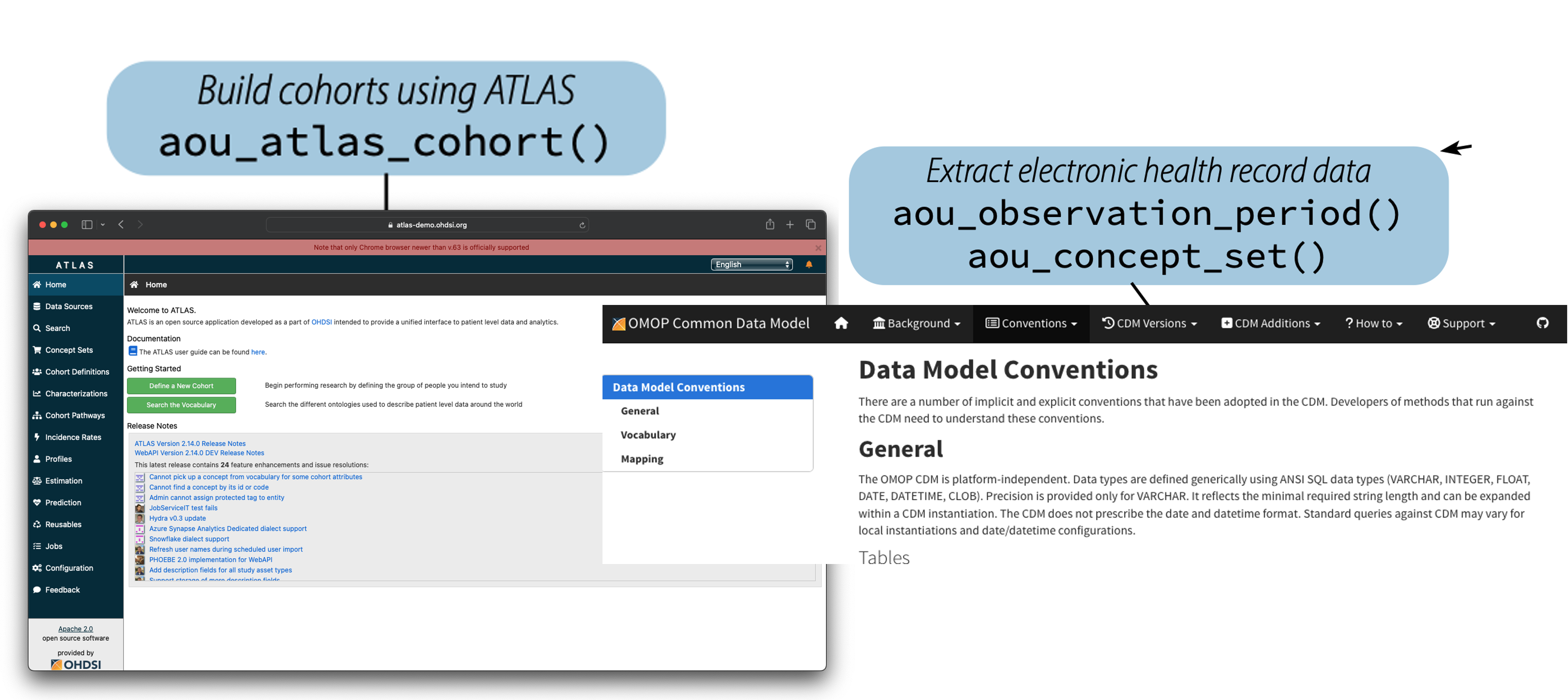
Challenges in fully integrating other OHDSI software
- No direct write access
- Temp tables work differently
aou_compute()
Like dplyr::compute() – forces computation
aou_create_temp_table()
Copies a local data frame to a temporary table in the connected database (in batches as necessary)
function (data, nchar_batch = 1e+06, ..., con = getOption("aou.default.con"))
{
  {...}
  for (i in seq_along(batches)) {
        dataset <- datasets[i]
        s1 <- stringr::str_glue("CREATE TEMP TABLE {dataset} (\n{s1_str}\n);")
        s2 <- stringr::str_glue("INSERT INTO {dataset} ({paste(cn, collapse =\", \")})")
        s3 <- batches[i]
        s4 <- stringr::str_glue("SELECT * FROM {dataset};")
        q <- paste(s1, s2, s3, s4)
        tmptbl_object <- bigrquery::bq_project_query(Sys.getenv("GOOGLE_PROJECT"),
            query = q)
        n[[i]] <- dplyr::tbl(con, paste(tmptbl_object$project,
            tmptbl_object$dataset, tmptbl_object$table, sep = (".")))
  }
  final_tbl <- purrr::reduce(n, dplyr::union_all)
  {...}
}
aou_create_temp_table()
[1] "terra-vpc-sc-07d9a2ac._5e8cebc37c5303ccccd8c889e44de664222a9786.anon8daf0d7bf0928b865ebae9fe169111e4f21636f52ee032338b018d8da11852e3"Other functions
Thank you!
- Smith LH, Cavanaugh R. allofus: an R package to facilitate use of the All of Us Researcher Workbench. Journal of the American Medical Informatics Association. 2024;31(12):3013-3021. doi: 10.1093/jamia/ocae198
- GitHub (source code, bug reports): github.com/roux-ohdsi/allofus
- Package site (tutorials, searchable codebooks): roux-ohdsi.github.io/allofus