
Step 1. Generate a sequence cohort
Source:vignettes/a02_Generate_a_sequence_cohort.Rmd
a02_Generate_a_sequence_cohort.RmdIntroduction
In this vignette we will explore the functionalities of
generateSequenceCohort().
Create a cdm object
The CohortSymmetry package is designed to work with data mapped to OMOP CDM, so the first step is to create a mock database using the omock package. We will use the Eunomia dataset within omock for the subsequent examples. There are other synthetic datasets within omock that users can also use to get familiar with CohortSymmetry before applying to their own database. See the omock vignette for more details.
library(omock)
library(CohortSymmetry)

cdm <- mockCdmFromDataset(datasetName = "GiBleed")
Instantiate two cohorts in the cdm reference
CohortSymmetry package requires that the cdm object contains two cohort tables: the index cohort and the marker cohort. There are a lot of different ways to create these cohorts, and it will depend on what the index cohort and marker cohort represent. If one wants to generate two drugs cohorts in cdm, we recommend using CohortConstructor R package however, the DrugUtilisation R package can also be used. However a user will need to specify the gap eras for each of the cohorts i.e. a gap era set to 30 would collapse episodes together if they are within 30 days of each other for example please see the individual packages on how to implement this if required. Here is the example code for CohortConstructor:
library(dplyr)
library(CodelistGenerator)
library(CohortConstructor)

aspirin_codelist <- CodelistGenerator::getDrugIngredientCodes(
  cdm = cdm,
  name = "aspirin",
  nameStyle = "{concept_name}"
)

cdm[["aspirin"]] <- CohortConstructor::conceptCohort(
  cdm = cdm,
  conceptSet = aspirin_codelist,
  exit = "event_end_date",
  name = "aspirin")


amoxicillin_codelist <- CodelistGenerator::getDrugIngredientCodes(
  cdm = cdm,
  name = "amoxicillin",
  nameStyle = "{concept_name}"
)

cdm[["amoxicillin"]] <- CohortConstructor::conceptCohort(
  cdm = cdm,
  conceptSet = amoxicillin_codelist,
  exit = "event_end_date",
  name = "amoxicillin")
Here is some example code for DrugUtilisation:
library(DrugUtilisation)

cdm <- DrugUtilisation::generateIngredientCohortSet(
  cdm = cdm,
  name = "aspirin",
  ingredient = "aspirin")

cdm <- DrugUtilisation::generateIngredientCohortSet(
  cdm = cdm,
  name = "amoxicillin",
  ingredient = "amoxicillin")
Generate a sequence cohort
In order to initiate the calculations, the two cohorts tables need to
be intersected using generateSequenceCohortSet(). This
process will output all the individuals who appear on both tables
subject to different parameters. Each parameter corresponds to a
specific requirement. The parameters for this function include
cohortDateRange, daysPriorObservation,
washoutWindow, indexMarkerGap and
combinationWindow. Let’s go through examples to see how
each parameter works.
No specific requirements
Let’s study the simplest case where no requirements are imposed. See figure below to see an example of an analysis containing six different participants.
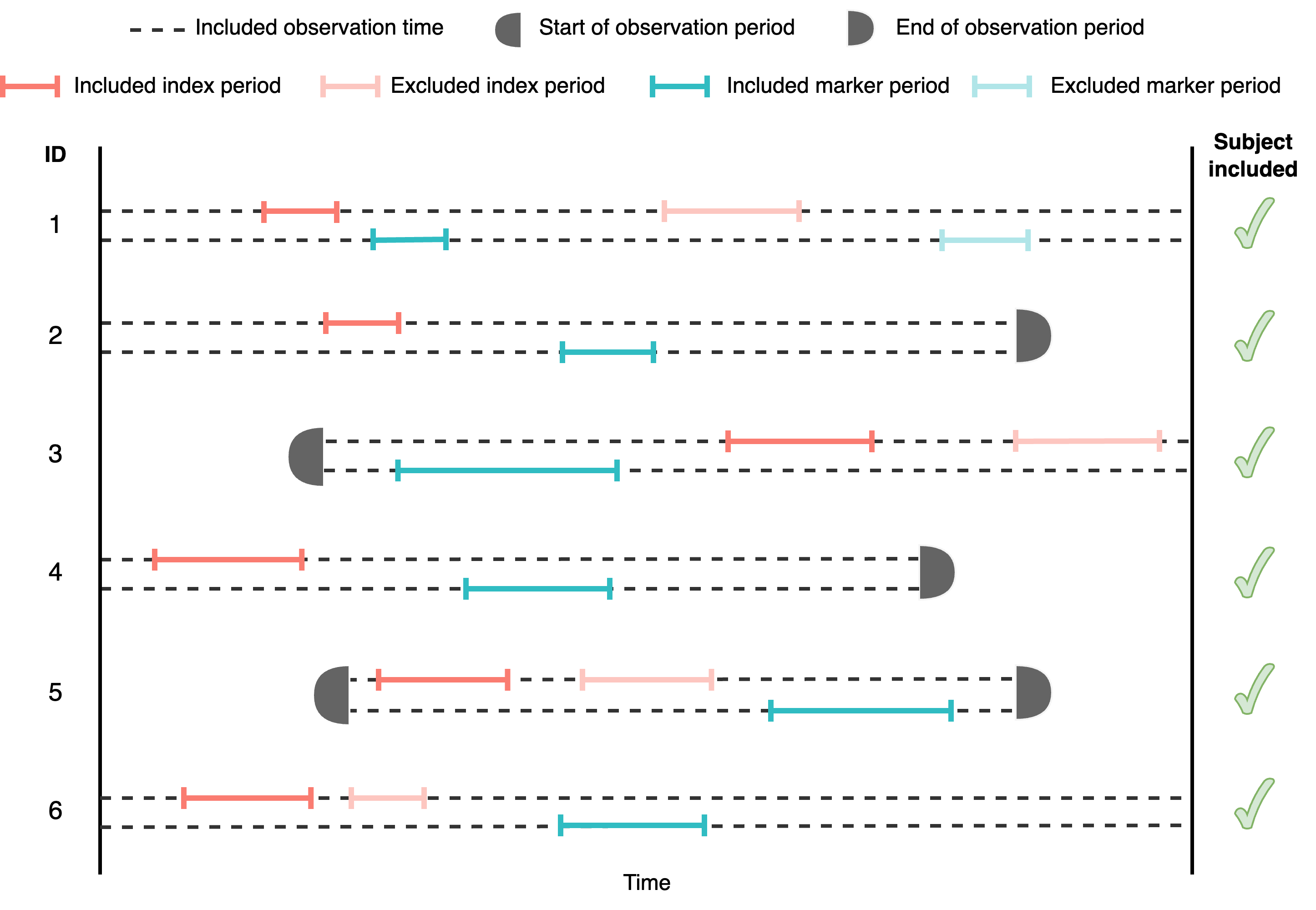
See that only the first event/episode (for both the index and the marker) is included in the analysis. As there is no restriction criteria and all the individuals have an episode in the index and the marker cohort, all the subjects are included in the analysis. We can get a sequence cohort without including any particular requirement like so:
cdm <- generateSequenceCohortSet(
  cdm = cdm,
  indexTable = "aspirin",
  markerTable = "amoxicillin",
  name = "intersect",
  cohortDateRange = as.Date(c(NA, NA)),
  daysPriorObservation = 0,
  washoutWindow = 0,
  indexMarkerGap = Inf,
  combinationWindow = c(0,Inf))

cdm$intersect |>
  dplyr::glimpse()
#> Rows: 1,510
#> Columns: 6
#> $ cohort_definition_id <int> 1, 1, 1, 1, 1, 1, 1, 1, 1, 1, 1, 1, 1, 1, 1, 1, 1…
#> $ subject_id           <int> 4960, 3342, 2088, 5328, 4547, 5295, 4680, 4739, 4…
#> $ cohort_start_date    <date> 1909-06-16, 1910-02-02, 1910-02-14, 1910-02-26, …
#> $ cohort_end_date      <date> 1943-05-05, 1912-05-27, 1914-01-20, 1921-10-31, …
#> $ index_date           <date> 1909-06-16, 1910-02-02, 1910-02-14, 1910-02-26, …
#> $ marker_date          <date> 1943-05-05, 1912-05-27, 1914-01-20, 1921-10-31, …
Important Observations
See that the generated table has the format of an OMOP CDM cohort,
but it also includes two additional columns: the index_date
and the marker_date, which are the
cohort_start_date of the index and marker episode
respectively. The cohort_start_date and the cohort_end_date
are defined as:
-
cohort_start_date: earliestcohort_start_datebetween the index and the marker events. -
cohort_end_date: latestcohort_start_datebetween the index and the marker events.
The cohort_definition_id in the output is associated
with the cohort_definition_id} of the index table
(indexId) and the cohort_definition_id of the
marker table (markerId). To see the correspondence, one
could do the following:
attr(cdm$intersect, "cohort_set")
#> # A tibble: 1 × 13
#>   cohort_definition_id cohort_name     index_id index_name marker_id marker_name
#> *                <int> <chr>              <int> <chr>          <int> <chr>
#> 1                    1 index_aspirin_…        1 aspirin            1 amoxicillin
#> # ℹ 7 more variables: cohort_date_range <chr>, days_prior_observation <chr>,
#> #   washout_window <chr>, index_marker_gap <chr>, combination_window <chr>,
#> #   moving_average_restriction <chr>, nsr <dbl>
The user may also wish to subset the index table and marker table
based on their cohort_definition_id using indexId and
markerId respectively. For example, the following code only
includes cohort_definidtion_id
from both the index and the marker table.
cdm <- generateSequenceCohortSet(
  cdm = cdm,
  indexTable = "aspirin",
  markerTable = "amoxicillin",
  name = "intersect",
  cohortDateRange = as.Date(c(NA, NA)),
  indexId = 1,
  markerId = 1,
  daysPriorObservation = 0,
  washoutWindow = 0,
  indexMarkerGap = Inf,
  combinationWindow = c(0,Inf))
Specified study period
We can restrict the study period of the analysis to only include episodes or events happening during a specific period of time. See figure below to see an example of an analysis containing six different participants.
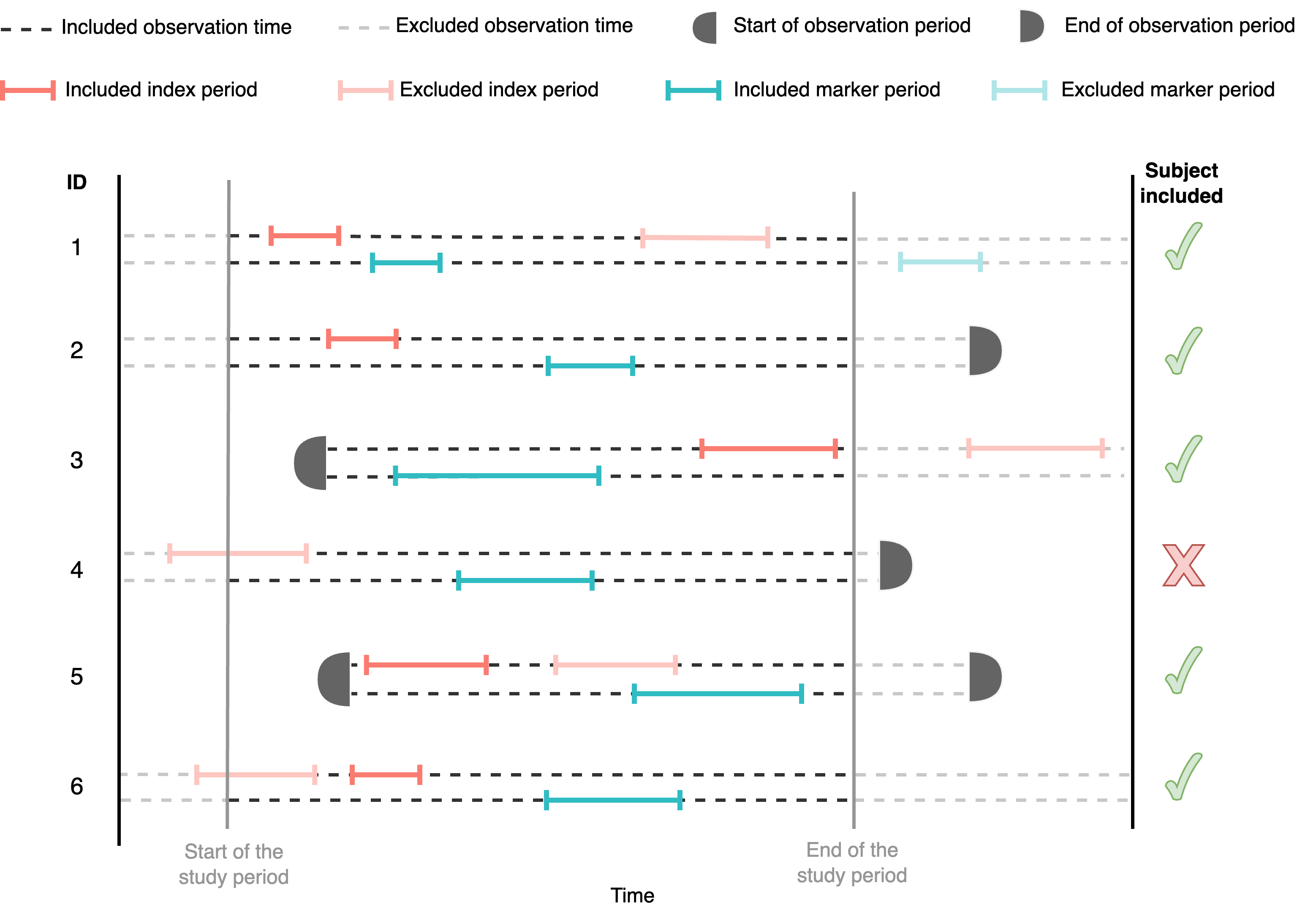
Notice that, by imposing a restriction on study period, some of the participants might be excluded. For example, participant 4 is excluded because the only index episode is outside of the study period whereas participant 6 is included because he/she does have an index episode within the study period.
The study period can be restricted using the
cohortDateRange argument, which is defined as:
cohortDateRange = c(start_of_the_study_period, end_of_the_study_period)
See an example of the usage below, where we have restricted the
cohortDateRange within 01/01/1950 until 01/01/1969.
cdm <- generateSequenceCohortSet(
  cdm = cdm,
  indexTable = "aspirin",
  markerTable = "amoxicillin",
  name = "intersect_study_period",
  daysPriorObservation = 0,
  washoutWindow = 0,
  indexMarkerGap = Inf,
  cohortDateRange = as.Date(c("1950-01-01","1969-01-01")))
Specified study period and prior history requirement
We can also specify the minimum prior history that an individual has to have before the start of the first event in the sequence. This just asks “Does the person have enough prior observation history based on which event occurred first?” It applies this on the sequence so this can be applied to either index or marker event depending on which is first. Individuals with not enough prior history will be excluded. See the figure below, imagine the prior observation history is set to be 31 days, then participant 5 would be excluded because the first event happening within the study period does not have more than (or equal to) 31 days of prior history:
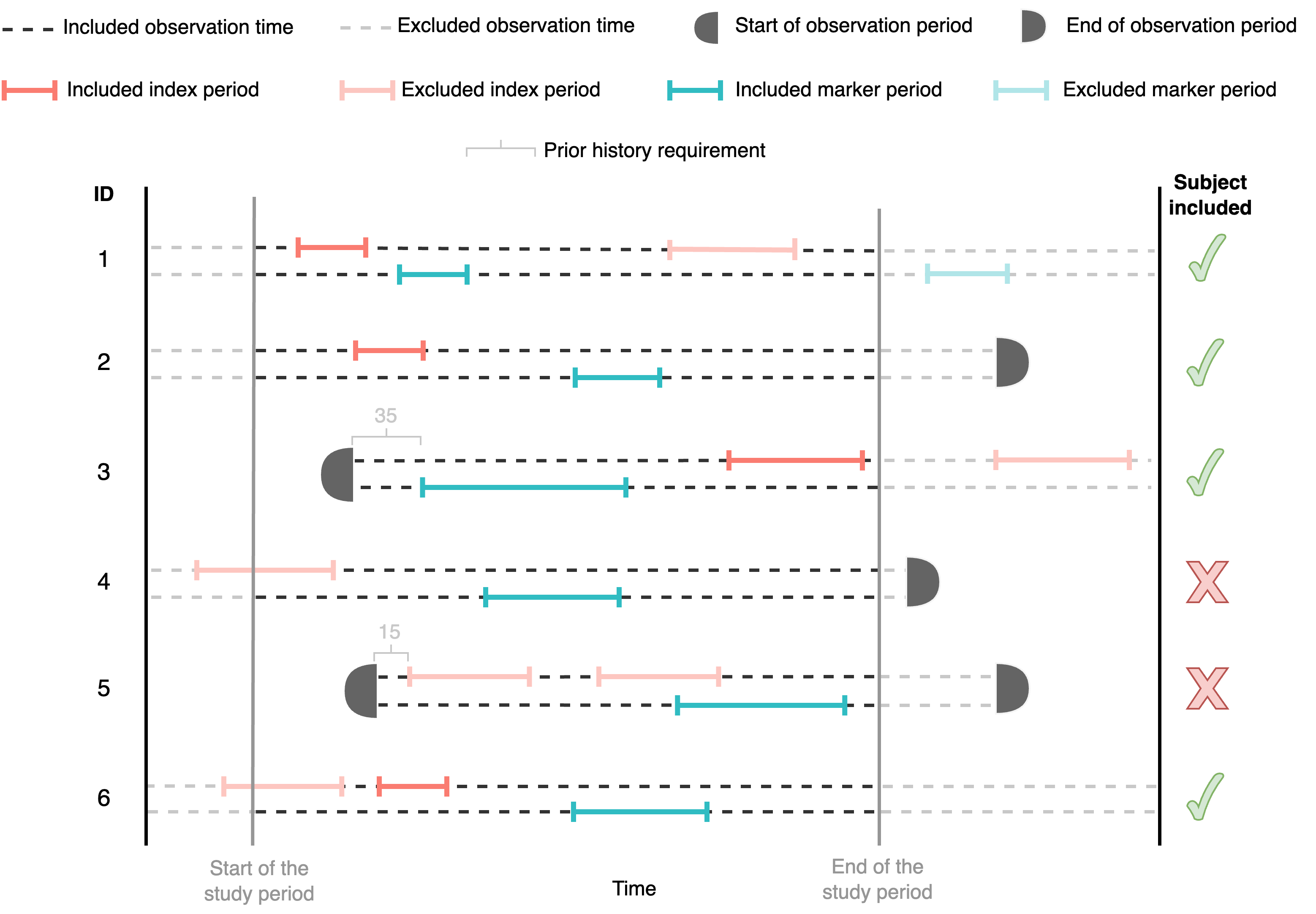
The number of days of prior history required can be implemented using
the argument daysPriorObservation. See an example
below:
cdm <- generateSequenceCohortSet(
  cdm = cdm,
  indexTable = "aspirin",
  markerTable = "amoxicillin",
  name = "intersect_prior_obs",
  cohortDateRange = as.Date(c("1950-01-01","1969-01-01")),
  daysPriorObservation = 365,
  washoutWindow = 0,
  indexMarkerGap = Inf)
Specified study period, prior history requirement and washout period
We can also specify the minimum washout period required for an event or episode to be included to restrict to incident users. In the following figure, we exclude participant 6 as another episode took place within the washout period. Washout period is applied to both the index and marker respectively.
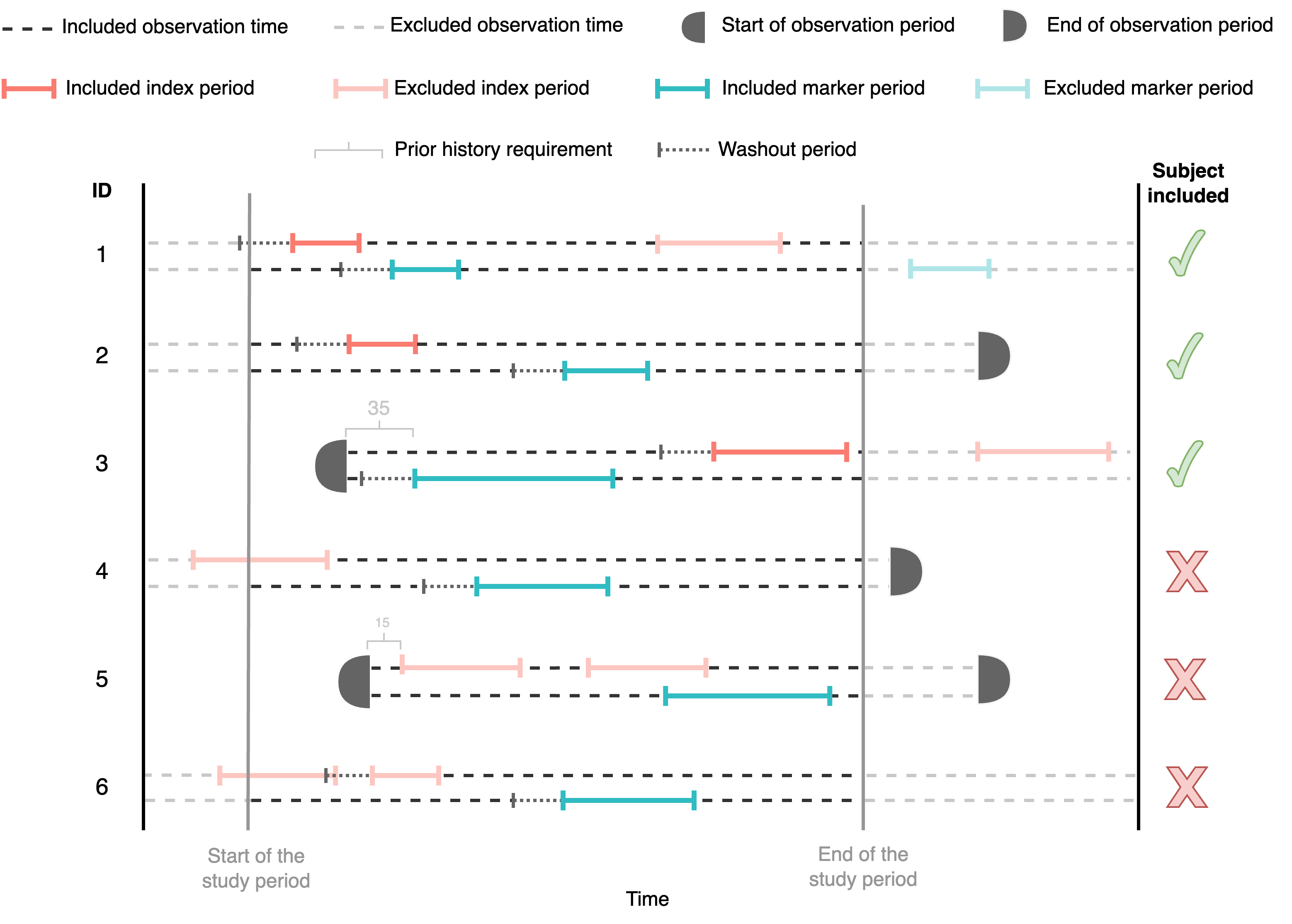
This functionality can be implemented using the
washoutWindow argument. See an example below:
cdm <- generateSequenceCohortSet(
  cdm = cdm,
  indexTable = "aspirin",
  markerTable = "amoxicillin",
  name = "intersect_washout",
  cohortDateRange = as.Date(c("1950-01-01","1969-01-01")),
  daysPriorObservation = 365,
  washoutWindow = 365,
  indexMarkerGap = Inf)
Specified study period, prior history requirement and combination window
We define the combination window as the minimum and the maximum days between the start of the first event (either if is the index or the marker) and the start of the next event. So a index and marker must be within so many days of one another. In other words:
second_episode(start_date)
first_episode(start_date);
combinationWindow[1]
combinationWindow[2]
combinationWindow = c(0,20). This means that the gap
between the start date of the second episode and the start of the first
episode should be larger than 0 and less or equal than 20. As
participant 2 and 3 do not fulfill this condition, they are excluded
from the analysis.
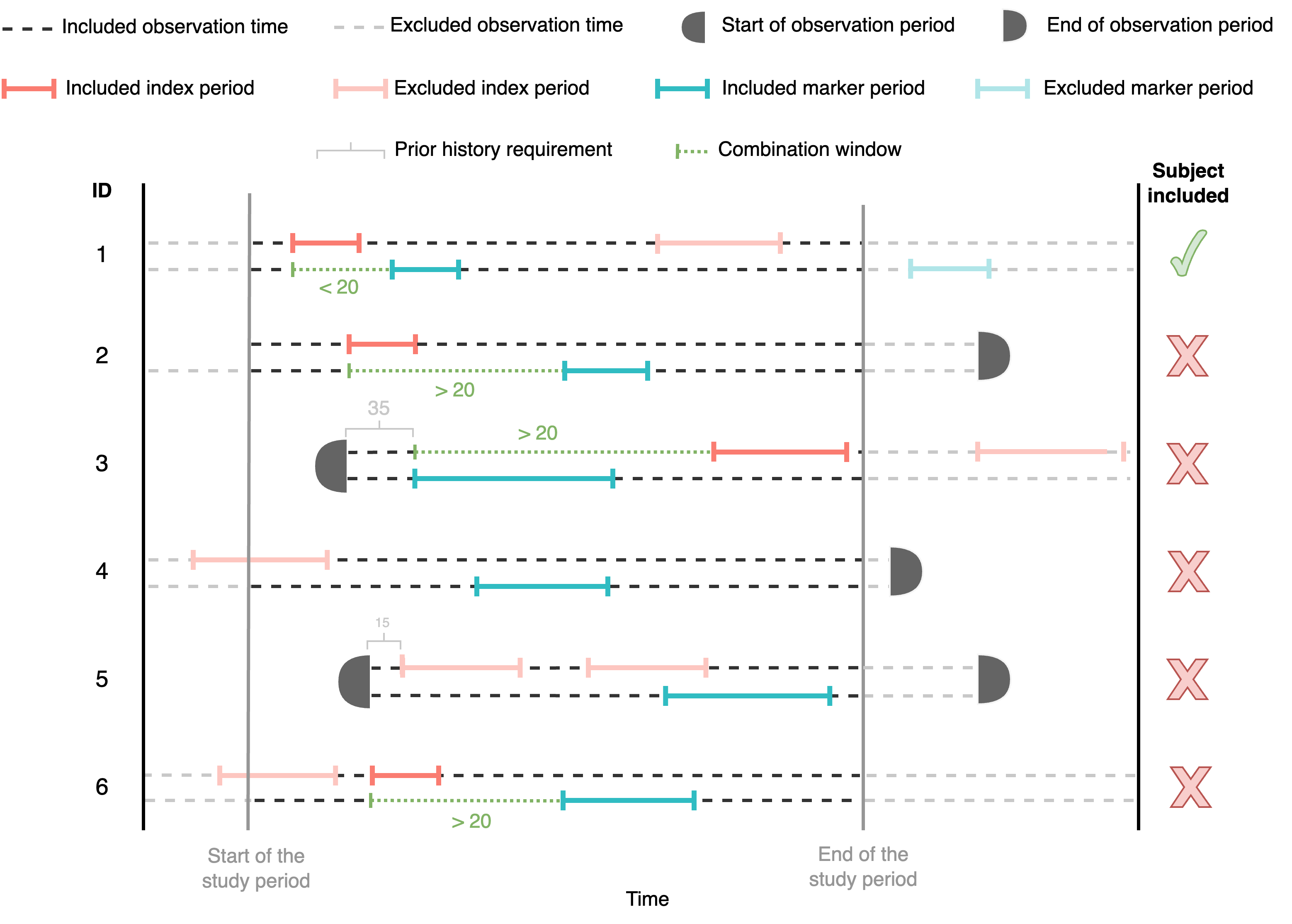
In the generateSequenceCohortSet() function, this is
implemented using the combinationWindow argument. Notice
that in the previous examples, as we did not want any combination window
requirement, we have set this argument to
combinationWindow = c(0,Inf), but the default is
combinationWindow = c(0, 365). In the following example, we
explore subject_id 80 and 187 to see the functionality of this argument.
When using no restriction for the combination window, both are included
in the intersect_changed_cw cohort:
cdm <- generateSequenceCohortSet(
  cdm = cdm,
  indexTable = "aspirin",
  markerTable = "amoxicillin",
  name = "intersect_changed_cw",
  cohortDateRange = as.Date(c("1950-01-01","1969-01-01")),
  daysPriorObservation = 365,
  washoutWindow = 365,
  indexMarkerGap = Inf,
  combinationWindow = c(0, Inf))

 cdm$intersect_changed_cw |>
   dplyr::filter(subject_id %in% c(80,187)) |>
   dplyr::mutate(combinationWindow = pmax(index_date, marker_date) - pmin(index_date, marker_date))
Furthermore, for the combinationWindow argument, a user
can also set the minimum window so
combinationWindow = c(7,365) for example. This allows for a
blackout window/period to be applied as described in Hendrix et
al. (2024). So in other words if a user knows that the index and
marker cannot occur within 7 days of each other this can be set and by
setting this it would exclude sequences in which two events occur 7 days
or fewer days apart, while retaining sequences occuring 8-365 days
apart.
Specified study period, prior history requirement and index marker gap
We define the index-marker gap to refer to the maximum number of days between the start of the second episode and the end of the first episode. That means:
second_episode(cohort_start_date)
first_episode(cohort_end_date);
x
indexMarkerGap
See an example below, where all participants with an index-marker gap higher than 30 days are excluded from the analysis and in this case this is no one as participants 2-6 have already been excluded due to not fufilling previous criteria and participant 1 fufills the index-marker gap:
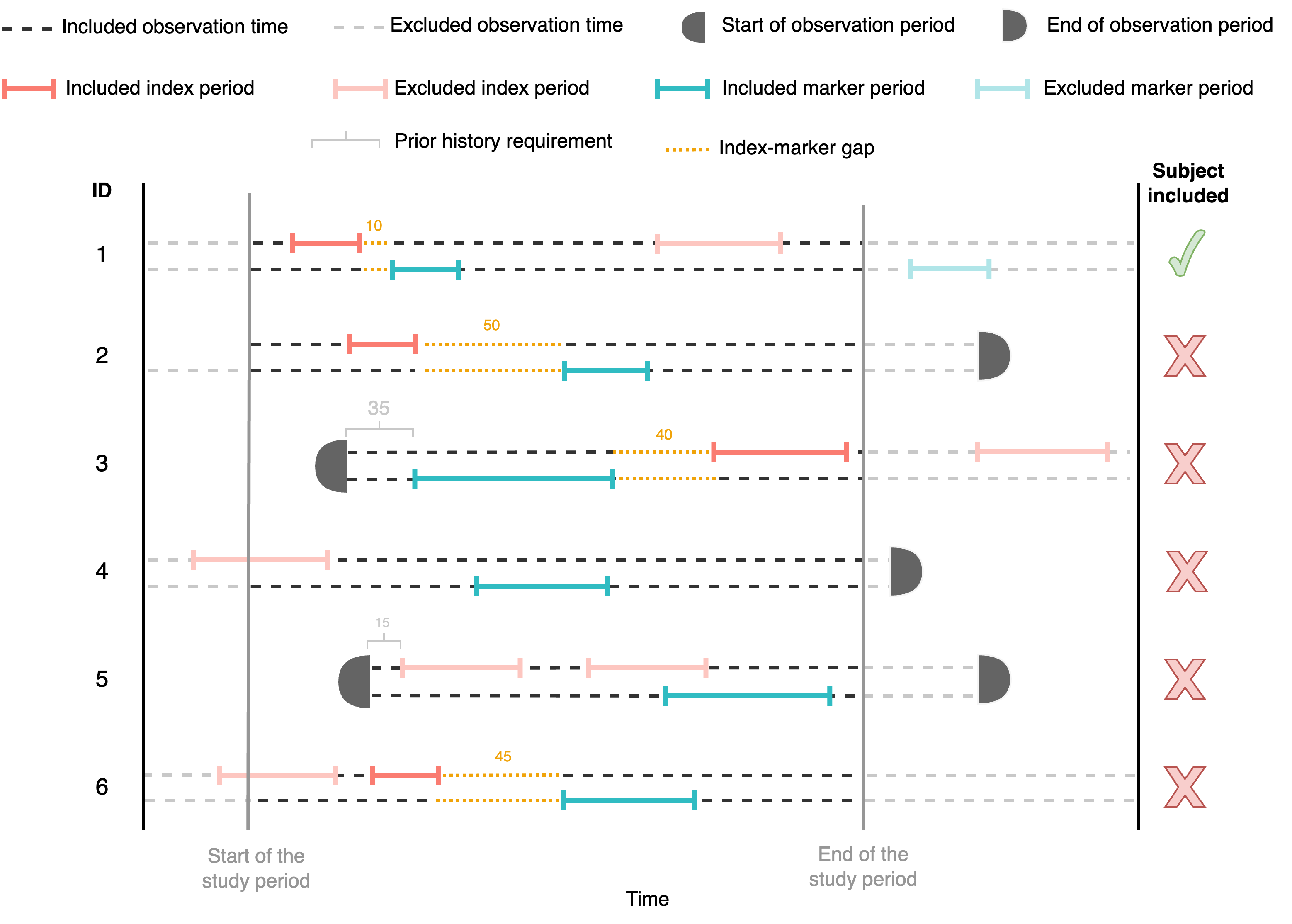
The default for indexMarkerGap = Inf meaning that no
restriction is imposed on the interval between the end of the first
event and start of the second. This is in line with established SSA
methodology, as SSA evaluates asymmetry in sequences rather than
duration of concurrent exposure.
However, this setting can be updated to implement a continued
exposure interval (CEI) used in prescription-cascade analyses. By
setting this parameter it specifies the maximum permitted interval
between the end of the first event and start of the second. For example
Hendrix et
al. (2024) applied a 4 month CEI to account for uncertainty in the
estimated end of medication exposure. Analogous to this
aindexMarkerGap = 120 would be used for this argument.
An example of the indexGap argument to impose this
restriction, for example is shown below:
cdm <- generateSequenceCohortSet(
  cdm = cdm,
  indexTable = "aspirin",
  markerTable = "amoxicillin",
  name = "intersect_",
  cohortDateRange = as.Date(c("1950-01-01","1969-01-01")),
  daysPriorObservation = 365,
  washoutWindow = 365,
  indexMarkerGap = 7)